Loading…
← All schools
School of the Art Institute of Chicago
Chicago, ILprivate nonprofitwww.saic.edu/
- Acceptance rateThe share of applicants a college admits in a given year. A 10% acceptance rate means it admits about 1 in 10 applicants.
- 77%
- Undergrad enrollment
- 2,805
- Net priceWhat a family actually pays after grants and scholarships are subtracted from the sticker price — usually far less than the published cost.
- $49,790
- In-state tuition
- $56,420
- Out-of-state tuition
- $56,420
- Location
- Downtown Chicago, IL
- Notable Fact
- 47% of students from top 20% income bracket
- Acceptance Rate
- 77%
- Graduation Rate
- 64%
- Average Aid Package
- $18,069
- Median Early-Career Earnings
- $36,427
Quick answers
- What is the acceptance rate at School of the Art Institute of Chicago?
- School of the Art Institute of Chicago's acceptance rate is approximately 77% (Chicago, IL), based on the most recent figures we compiled from public and primary sources.
- How much does School of the Art Institute of Chicago cost?
- At School of the Art Institute of Chicago, the average net price (after aid) is about $49,790 per year. Actual cost varies with financial aid and residency.
- How many undergraduates attend School of the Art Institute of Chicago?
- School of the Art Institute of Chicago enrolls approximately 2,805 undergraduate students.
- Where is School of the Art Institute of Chicago located?
- School of the Art Institute of Chicago is located in Chicago, IL.
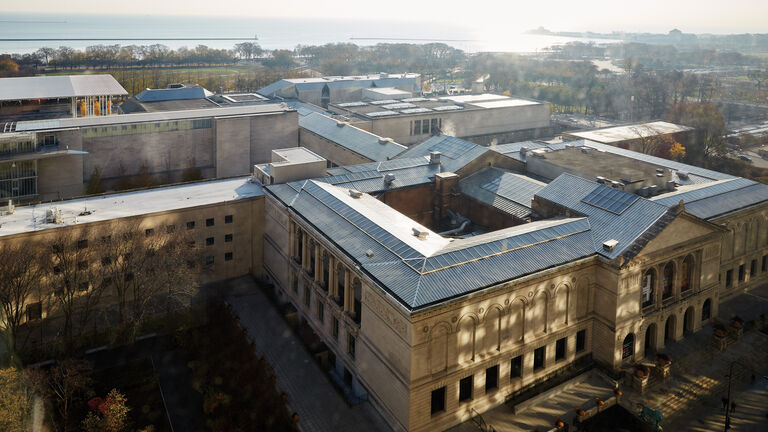
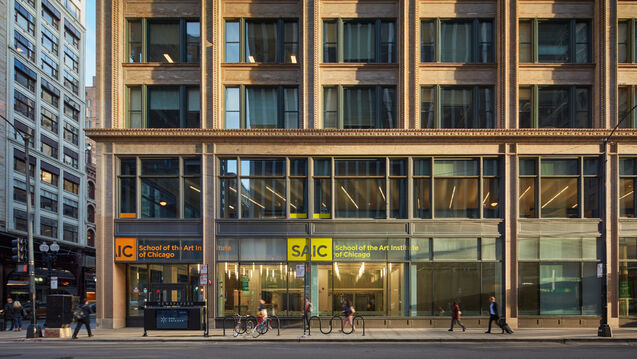
The School of the Art Institute of Chicago (SAIC) is a fiercely experimental art school where rigor collides with creative risk-taking. With its prime location in Chicago's cultural heart, SAIC offers an interdisciplinary, critique-driven education that attracts students more interested in pushing boundaries than following traditional paths—though early-career earnings lag behind expectations for many graduates.
Admissions
SAIC is notably accessible for a top-tier art school, with an Acceptance rateThe share of applicants a college admits in a given year. A 10% acceptance rate means it admits about 1 in 10 applicants. hovering around 77% (though the school claims it's closer to 57%). Applications are due by April 15, and the process leans heavily on portfolio reviews—standardized test scores are deemphasized, with admitted students averaging ACT scores between 22-25. The school's open admissions vibe reflects its experimental ethos: this isn't a place for gatekeeping, but for finding students who'll thrive in its unstructured, critique-heavy environment.
- Undergraduate acceptance rate: 77.5% (5,133 admits from 6,626 applications in 2024)
- Self-reported acceptance rate: ~57% (per SAIC's FAQ)
- Application deadline: April 15 (regular decision)
Sources
- Consumer Information | School of the Art Institute of Chicago
- Common Data Set | data.uchicago.edu - Institutional Analysis
- School of the Art Institute of Chicago | Data USA
- School of the Art Institute of Chicago - Institution Data Profile
- [PDF] Common Data Set 2022-2023 - ArtCenter College of Design
- School of the Art Institute of Chicago Overview - CollegeData
- School of the Art Institute of Chicago SAT Scores and GPA
- School of the Art Institute of Chicago Admissions - BigFuture
- School of the Art Institute of Chicago Admissions
- School of the Art Institute of Chicago (SAIC) - The Princeton Review