Acceptance rateThe share of applicants a college admits in a given year. A 10% acceptance rate means it admits about 1 in 10 applicants.
34%
SAT 25th-75th percentileThe middle range of SAT scores for admitted students: a quarter scored below the low number and a quarter scored above the high number.
1110–1300
Undergrad enrollment
962
Net priceWhat a family actually pays after grants and scholarships are subtracted from the sticker price — usually far less than the published cost.
$6,174
In-state tuition
$895
Out-of-state tuition
$895
Location
Kings Point, NY
Campus Size
82 acres
Notable Perk
$0 tuition + merchant marine license
Acceptance Rate
~25-34%
Graduation Rate
81% (77% in 4 years)
Post-Grad Service
5 years in maritime/military
Undergrad Enrollment
962 (2024)
Quick answers
What is the acceptance rate at United States Merchant Marine Academy?
United States Merchant Marine Academy's acceptance rate is approximately 34% (Kings Point, NY), based on the most recent figures we compiled from public and primary sources.
What SAT score do you need for United States Merchant Marine Academy?
Admitted students at United States Merchant Marine Academy typically score 1110–1300 on the SAT (the middle-50% range). Scores outside this band are still admitted, especially with strong applications.
How much does United States Merchant Marine Academy cost?
At United States Merchant Marine Academy, the average net price (after aid) is about $6,174 per year. Actual cost varies with financial aid and residency.
How many undergraduates attend United States Merchant Marine Academy?
United States Merchant Marine Academy enrolls approximately 962 undergraduate students.
Where is United States Merchant Marine Academy located?
United States Merchant Marine Academy is located in Kings Point, NY.
The United States Merchant Marine Academy (USMMA) at Kings Point is the most maritime of the federal service academies—a no-frills, regimented proving ground where midshipmen earn both a bachelor's degree and a merchant marine officer's license. With a grueling acceptance rate hovering around 25-34%, its graduates enter the workforce with near-guaranteed employment (often on ships or in military logistics) and some of the highest early-career salaries in higher education. Campus life is Spartan, but the academy's waterfront location and tight-knit regimental culture forge resilient leaders for global supply chains and national defense.
Admissions
Gaining admission to Kings Point is a gauntlet—Acceptance rateThe share of applicants a college admits in a given year. A 10% acceptance rate means it admits about 1 in 10 applicants. fluctuate between 21-34%, with roughly 1,370-2,000 applicants competing for 280-468 spots annually. The academy doesn't publish average GPAs, but successful candidates typically post SAT scores between 570-660 for Critical Reading and 611-686 for Math, or ACT composites of 23-29. Unlike traditional colleges, USMMA requires applicants to secure a congressional nomination (similar to West Point or Annapolis), adding another layer of selectivity. Notably, 87% of students come from out of state, reflecting its national draw. The February 1 application deadline is strict, and the admissions office emphasizes leadership potential and physical fitness alongside academic metrics.
USMMA’s curriculum is a four-year pressure cooker blending engineering, maritime law, and hands-on ship operations. Every graduate earns a Bachelor of Science and a Merchant Marine Officer license, qualifying them to serve as third mates or third assistant engineers on commercial vessels. The most specialized majors are Transportation (94 degrees awarded in 2024) and Engineering (129 degrees), with popular tracks in Systems Engineering and Marine Engineering. The student-faculty ratio is unlisted, but the program’s intensity is legendary—midshipmen spend summers at sea (including a grueling "Sea Year" aboard working ships) and adhere to a military-style regimental system. While academic support exists, the workload is notoriously demanding, with courses designed to mirror real-world maritime challenges.
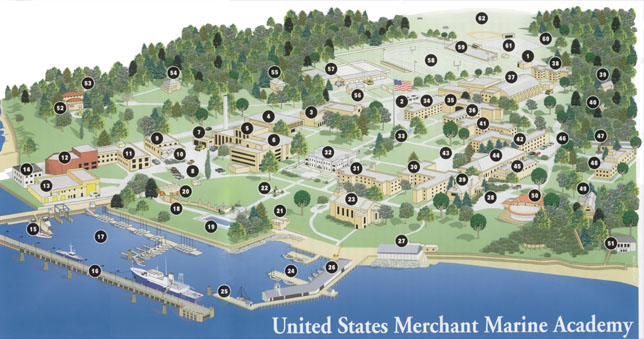
Life at Kings Point is austere and tightly regimented. The 82-acre campus—formerly Walter Chrysler’s waterfront estate—houses 962 undergraduates in no-frills dorms where complaints about erratic hot water and mold surface online. Social life revolves around the regiment: mandatory formations, uniform inspections, and military drills dominate the schedule. There’s no Greek life, and extracurriculars lean toward practical maritime skills (e.g., sailing teams, engine room simulations). The academy’s location on Long Island Sound offers waterfront access, but liberty is limited—upperclassmen earn weekend passes, while plebes face stricter confines. Alumni describe the culture as “borderline high school” but intensely bonding, with shared hardship forging lifelong camaraderie.
USMMA delivers jaw-dropping ROI. The 81% graduation rate (77% in four years) outpaces national averages, though attrition is steep—some cohorts shrink from 280 to 190 by graduation. Alumni enter the workforce with median salaries near $113,000 within four years, thanks to mandatory service obligations in the maritime industry or military. Nearly all graduates secure immediate employment, often aboard commercial ships (with salaries boosted by sea duty) or in Navy/Marine Corps logistics. The academy’s niche focus means its network dominates global shipping: CEOs of Maersk and Crowley Maritime are Kings Point alumni, and graduates are exempt from typical entry-level grunt work in the industry.
Tuition is fully covered by the federal government in exchange for five years of post-graduation service (or military reserve duty). Midshipmen pay only fees ($4,891 annually after aid), a steal compared to private colleges. However, 18% of students receive additional aid, with average grants around $4,075. Unlike other service academies, USMMA doesn’t offer institutional scholarships, leaving students to rely on outside awards or federal loans for extras. The Net priceWhat a family actually pays after grants and scholarships are subtracted from the sticker price — usually far less than the published cost. calculator warns of costs like textbooks and uniforms, but the absence of tuition debt—coupled with high post-grad salaries—makes this one of higher ed’s most financially sound bets.
USMMA is the only federal academy where graduates enter civilian industries en masse—a unique hybrid of military discipline and private-sector pragmatism. Its license-to-work model ensures every graduate is job-ready, while the Sea Year program (where midshipmen crew commercial vessels) provides unmatched real-world experience. The academy’s tiny size and hyper-specialization create a cult-like alumni network in global shipping, and its $0 tuition (with earning potential rivaling Ivy League schools) makes it a stealth powerhouse for ROI. Downsides? The Spartan lifestyle isn’t for everyone, and the regimented culture can feel oppressive. But for those wired to lead in maritime trade or defense logistics, Kings Point is peerless.
United States Merchant Marine Academy logo · sourceCampus Map | U.S. Merchant Marine Academy · sourceUnited States Merchant Marine Academy - Wikipedia · sourceAbout USMMA | U.S. Merchant Marine Academy · source